
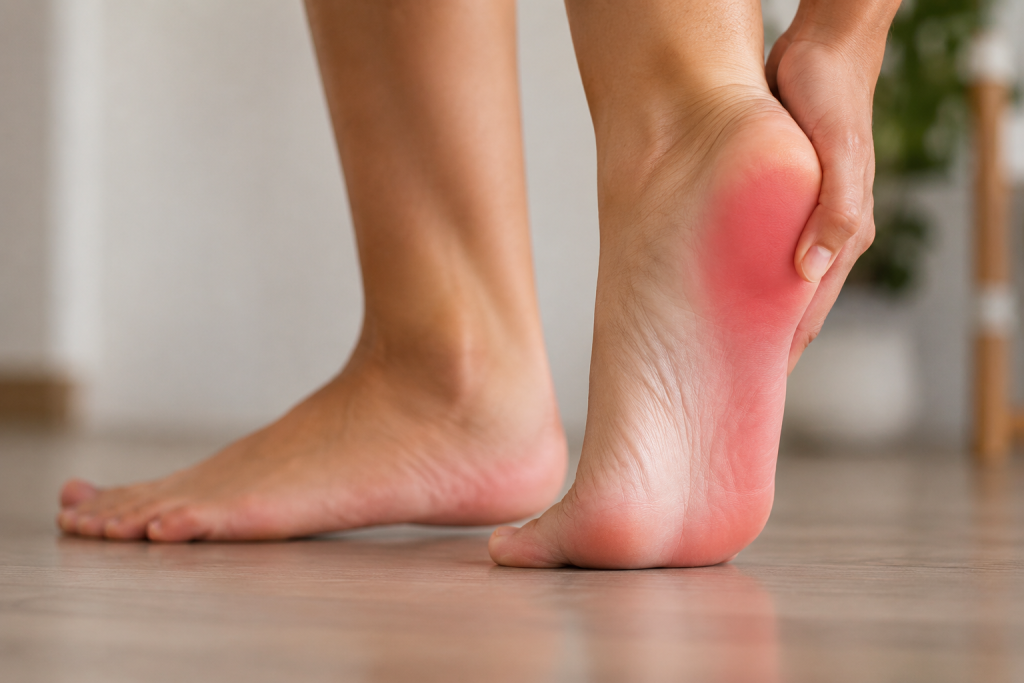
Plantar fasciitis is one of the most common causes of heel pain, often presenting as sharp discomfort with the first few steps in the morning or after periods of rest. While many conventional approaches focus locally on stretching the calf, orthotics, taping, or anti-inflammatory strategies, Fascial Counterstrain (FCS) offers a broader neurofascial perspective. FCS is a gentle manual therapy derived from traditional strain-counterstrain methods that aims to reduce protective reflex tension in fascia, ligaments, muscles, nerves, and vascular tissues. Research on counterstrain in plantar fasciitis has shown short-term symptom improvement, with one randomized controlled trial reporting significant relief of pain that lasted up to 48 hours after treatment sessions. Additional clinical studies have also demonstrated reductions in pain and disability with strain-counterstrain intervention.
Some Fascial Counterstrain educators also propose that dysfunction of the Ligamentum Flavum—the elastic spinal ligament lining the posterior spinal canal—can contribute to remote joint capsulitis patterns throughout the body depending on the spinal segment involved. In their teaching model, specific spinal levels may correlate with protective tightening in distal joints, including the feet. For example, lower lumbar and sacral levels such as L5, S1, and S2 are theorized to influence capsular restriction in the ankle, subtalar joints, and plantar fascial attachments. These claims are described in FCS training materials, which state that treatment of Ligamentum Flavum dysfunction may “correct capsulitis throughout the body,” including the feet. It is important to note, however, that this segment-specific retrograde capsulitis model remains largely theoretical and has limited independent peer-reviewed validation at present.
Clinically, when an FCS practitioner manually decompresses and releases perceived dysfunction at L5, S1, and S2, the goal is to reduce reflexive guarding through the lumbosacral-neural-fascial chain. If successful, this may lessen capsular tightness around the rearfoot and plantar fascia, improve gait mechanics, and decrease heel pain without aggressive local treatment. In practice, many patients report that once proximal spinal and pelvic restrictions are addressed, the plantar fascia becomes less tender and more resilient under load. For persistent plantar fasciitis cases—especially those that recur despite stretching and orthotics—FCS may offer a useful whole-body adjunct that addresses both local tissue irritation and upstream biomechanical drivers.