
Physical Therapy Services
Kinesio Taping
Support for muscles and joints between visits.
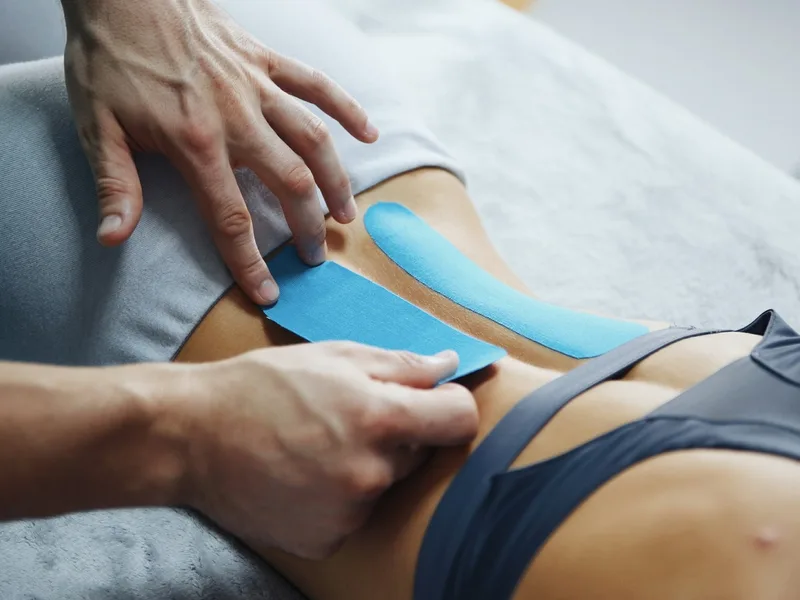
Kinesio Taping
Kinesiology Taping is a precise rehabilitative taping technique that is designed to facilitate the body’s natural healing process while providing support and stability to muscles and joints. This technique allows the body’s normal range of motion as well as providing extended soft tissue manipulation to prolong the benefits of manual therapy administered within the clinical setting.
Kinesio tape is latex-free and hypoallergenic, which makes it skin friendly for patients with sensitive or fragile skin such as patients with diabetes, fibromyalgia or rheumatoid arthritis. You can wear it for multiple days at a time. Because it is heat-activated, you can even wear it in the shower or pool without it peeling off. It is safe for patients of multiple age groups ranging from pediatric to geriatric, and it successfully treats a variety of orthopedic, neuromuscular, neurological and other medical conditions.
Kinesiology Taping is a therapeutic taping technique that not only offers patients the support they are looking for, but also provides rehabilitation. By targeting different receptors within the somatosensory system, kinesiology tape alleviates pain and facilitates lymphatic drainage by microscopically lifting the skin. This lifting effect forms convolutions in the skin, thus increasing interstitial space and allowing for a decrease in inflammation of the affected areas.
If you want to learn more about Kinesiology Taping and see if it is right for you, please contact us today at (212) 922-0044 to set up an appointment for your own evaluation.
How It Works
How Kinesio taping is applied
Kinesiology tape is an elastic cotton tape applied directly to the skin over and around the area being treated. The therapist chooses the direction, the amount of stretch and the anchor points based on what they want the tape to do — support a joint through range, offload a tender structure, or provide a constant cue to the skin over a region.
Application takes a few minutes at the end of a session. The tape is heat-activated by rubbing it down, and it is worn for several days including through showering.
What It Addresses
What Kinesio taping is used for
Taping is applied as part of a session, for presentations like these.
- Supporting a muscle or joint between visits without restricting movement
- Extending the effect of hands-on work performed in the session
- Providing a positional cue during activity, work or sport
- Patients with sensitive or fragile skin, as the tape is latex-free and hypoallergenic
What to Expect
One-on-one care, built around you
Your care begins with a one-on-one evaluation. Rather than focusing on the symptoms alone, we establish a cause and effect relationship through accurate palpation and assessment of the body, then build a rehabilitation program customized to your individual needs.
- Taping is applied as part of a treatment session rather than booked on its own.
- The skin over the area needs to be clean, dry and free of lotion. Heavy hair may be trimmed so the tape adheres and comes off comfortably.
- You will be shown how the tape should feel, what is normal, and how to remove it — slowly, in the direction of hair growth, ideally after a shower.
- Advice on how many days to keep it on and whether to re-tape, which depends on what it was applied for.
Common Questions
Questions we are asked about Kinesio Taping
- How long does the tape stay on?
- Typically several days. It is water-resistant, so you can shower and swim with it on. Your therapist will tell you how long to leave the specific application on and whether to come back to have it renewed.
- Will it irritate my skin?
- The tape is latex-free and hypoallergenic, which is why it is used with patients who have sensitive or fragile skin. Irritation is still possible. If the skin under the tape starts to itch, burn or redden, take it off and tell us.
- Can I put it on myself at home?
- Where the tape sits, which direction it runs and how much stretch is applied all depend on what it is meant to do, and that comes out of the assessment. Have it applied here rather than copying an application from a video.
- How do I take it off without it hurting?
- Remove it after a shower, when the adhesive is softened. Peel slowly along the direction of hair growth, pressing the skin down away from the tape as you go, rather than pulling it off quickly.